
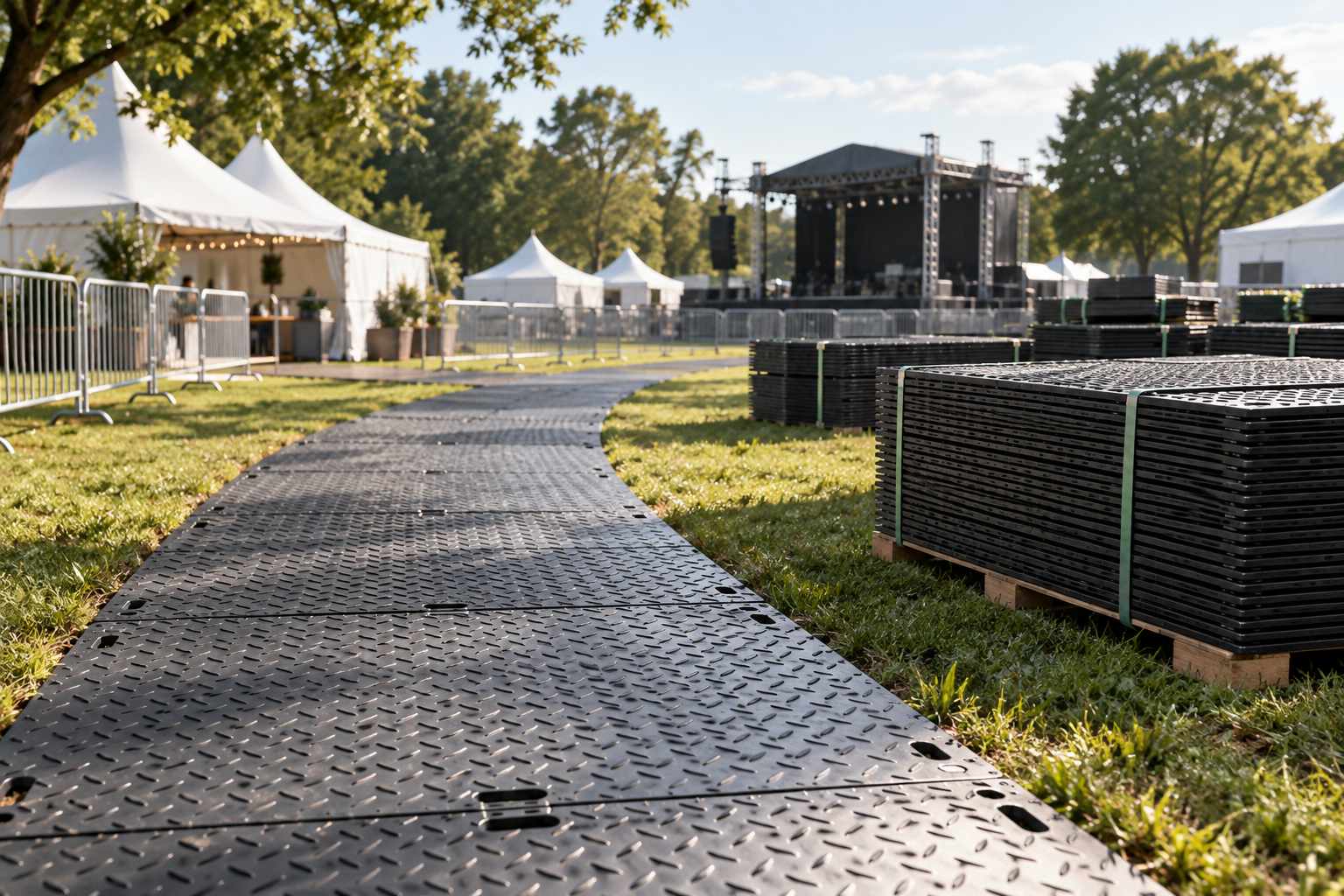
Outdoor events create a different ground-protection problem from conventional construction sites. The traffic may be lighter, but the surface underneath can be valuable, sensitive, landscaped, or difficult to restore. At the same time, event organizers need safe pedestrian access, service routes, equipment access, and a temporary surface that can be installed and removed within a limited schedule. Choosing suitable ground protection mats therefore requires a balance between load, ground condition, pedestrian use, appearance, drainage, handling, and event duration. For event contractors, venue managers, and procurement teams, the right approach is to divide the site according to how each area will actually be used rather than selecting one mat configuration for the entire venue.
What Areas of an Outdoor Event Need Ground Protection?
The first step is to map where protection is actually necessary. An event site may include lawns, pedestrian entrances, catering areas, temporary structures, service access routes, parking areas, and equipment zones. Each location can place different demands on the temporary surface.
Separate pedestrian areas from vehicle routes
A walkway used mainly by visitors does not experience the same loading as a route used by delivery trucks or forklifts. Treating both areas as one category can make the specification unnecessarily complicated or leave one area poorly suited to its purpose.
A site plan should identify at least three broad zones:
| Area | Main consideration |
|---|---|
| Pedestrian walkway | Slip resistance, comfort, appearance |
| Service route | Vehicle loading, traction, repeated traffic |
| Equipment area | Localized loading and ground stability |
This division also helps with budgeting. Instead of ordering the same material for every square meter, procurement can match different areas to their actual use.
The construction industry application provides useful context for temporary access and surface-protection requirements where construction equipment and temporary site facilities are involved.
Consider the value of the surface underneath
Grass, landscaped areas, heritage paving, finished courtyards, and other completed surfaces may have different restoration requirements. A temporary covering should protect the surface without creating a new problem during installation or removal.
For a venue with carefully maintained landscaping, ground protection should therefore be considered before delivery vehicles begin entering the site.
How Should Ground Conditions Influence Event Mat Selection?
Outdoor venues can look firm during a site visit and behave very differently after several days of rain. Ground condition is therefore one of the first variables that should be recorded before selecting a temporary covering.
Moisture changes the risk
Wet soil can lose strength under repeated traffic. Pedestrian areas may develop muddy patches, while vehicles can create ruts that become more difficult to repair after the event.
Drainage should be reviewed at the same time. Low points, natural runoff routes, irrigation systems, and temporary drainage channels can all affect how water moves beneath and around the protected area.
A useful site assessment can record:
- Soil condition
- Existing grass or landscaping
- Moisture level
- Drainage routes
- Slopes
- Areas with previous rutting
- Expected weather during the event
The purpose is not to assume that every wet area requires the same solution. It is to identify where the ground is most vulnerable.
Avoid trapping an existing drainage problem
A temporary surface should not be treated as a substitute for drainage planning. If water already accumulates in a particular location, covering it without considering how the water will escape can make site management more difficult.
The installation plan should therefore be reviewed alongside the venue’s drainage arrangements, especially where the protected area will remain in place for several days.
Which Surface Characteristics Matter Most for Pedestrian Areas?
For visitor walkways, the surface is judged differently from a heavy equipment route. Grip, walking comfort, drainage, and the transition between protected and unprotected areas can all affect how people move around the venue.
Traction becomes more important in wet weather
Rain can create a combination of wet footwear, muddy ground, and standing water. A temporary walkway should provide a reasonably predictable walking surface under those conditions.
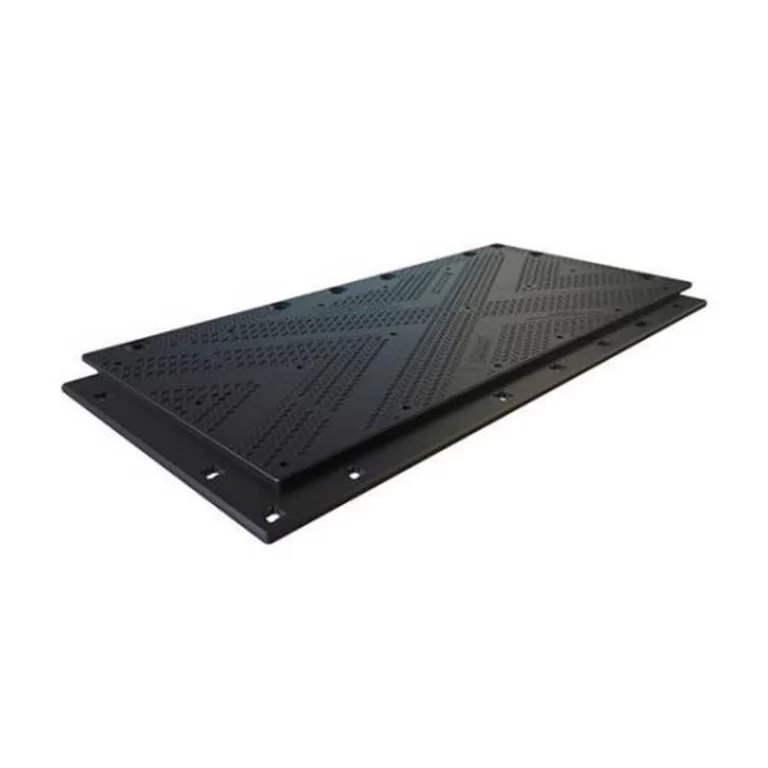
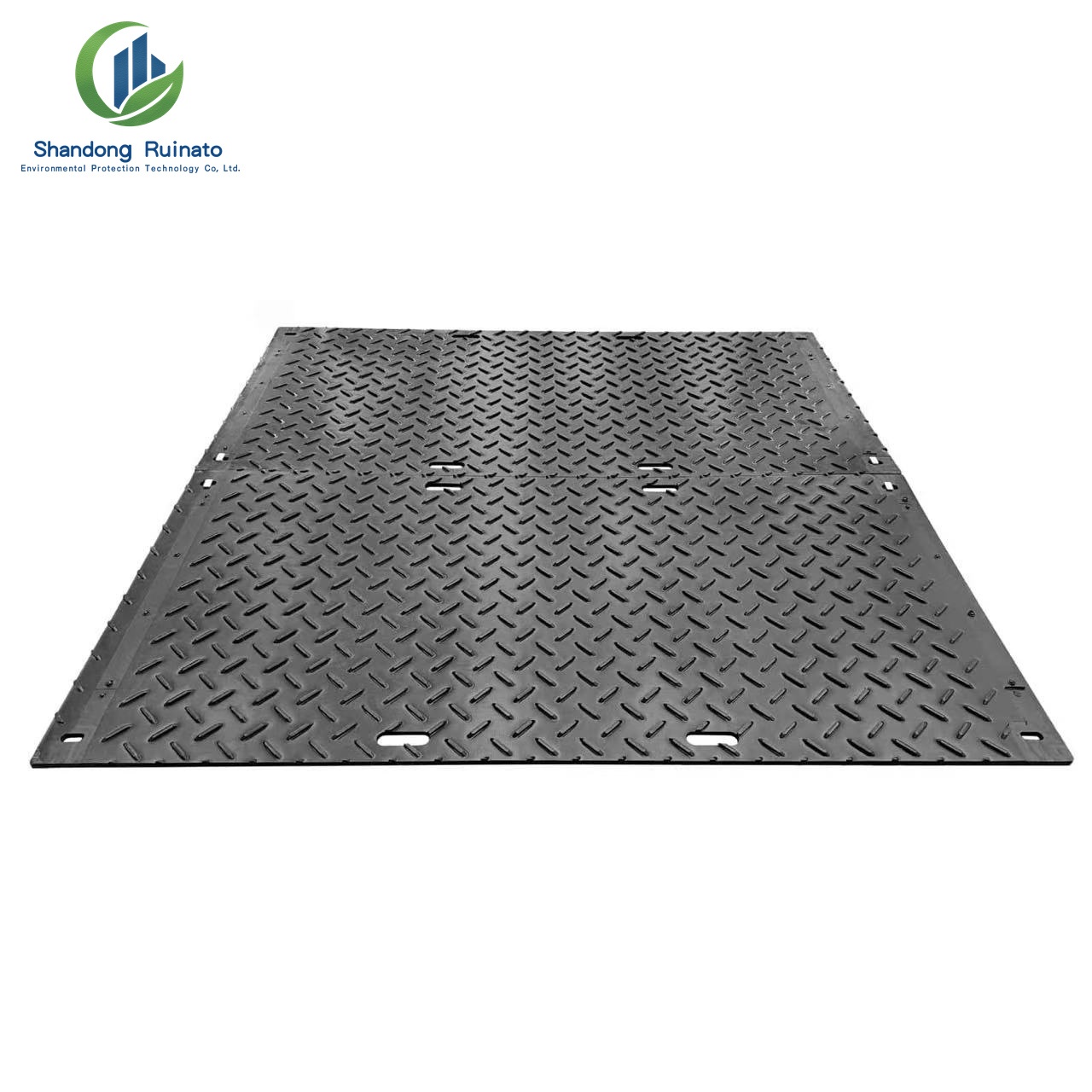
Surface texture is therefore not merely an aesthetic decision. Different textures can influence friction and water movement. The available technical information describes diamond, striped, willow leaf, and hexagonal surface patterns, with the striped pattern specifically described as having open-ended grooves for drainage of water and snow.
The choice should follow the expected environment rather than simply selecting the most aggressive-looking texture.
Transitions need as much attention as the mat itself
Visitors notice changes in level immediately. The edges of a temporary walkway, joins between panels, ramps, and transitions to existing paving should therefore be included in the layout review.
A walkway can perform well across its main surface while still creating a poor user experience if the entrance or exit has an awkward transition.
For event planners, this is also where accessibility requirements need to be considered alongside the temporary surface design.
How Should Panel Size and Layout Be Planned for an Event Site?
Event sites rarely have perfectly rectangular layouts. Paths curve around buildings, temporary structures occupy part of the venue, and service access may need to cross pedestrian routes. Panel dimensions should be considered against this geometry before the order is finalized.
Match panel dimensions to the site plan
The published technical information lists standard dimensions including 1220 × 2440 mm, 915 × 2440 mm, 915 × 1830 mm, 610 × 2440 mm, 610 × 1830 mm, and 610 × 1220 mm, with custom options also available.
These different formats can produce very different layouts.
For a straight walkway, a larger panel may reduce the number of joints. Around a curved path or restricted entrance, a smaller format may make positioning easier. The decision should be based on the venue drawing rather than on panel area alone.
Count the layout rather than estimating only by square meters
Suppose a walkway is 30 meters long and the planned protected width is 1.8 meters. The basic area is:
30 × 1.8 = 54 m²
That figure is useful for early budgeting, but it does not show how the panels will fit across the route. The final quantity depends on the selected panel dimensions, orientation, edge conditions, and any additional areas at entrances or intersections.
For events, it is often worth drawing the actual panel arrangement before placing the order. This makes the installation team aware of where complete panels, edge pieces, and transitions will occur.
The wider ground protection mat category can be used as a reference when comparing available configurations.
How Do Installation, Removal, and Reuse Affect Event Procurement?
Events operate on compressed schedules. A venue may have only a short period between site handover and opening, followed by an equally short period for dismantling. Installation speed and removal planning therefore deserve attention before the purchase order is issued.
Plan the installation around the event schedule
The temporary surface should be installed after the relevant ground and drainage work is complete but early enough to allow inspection before visitors arrive.
The installation plan should identify:
| Planning point | Why it matters |
|---|---|
| Delivery sequence | Prevents materials blocking active work |
| Installation order | Coordinates with site preparation |
| Access routes | Keeps installation equipment moving |
| Storage area | Prevents unnecessary handling |
| Removal sequence | Supports rapid site clearance |
For larger events, storing panels close to the installation zone may save handling time, but storage should not interfere with emergency access, contractor traffic, or other site operations.
Removal deserves the same planning as installation
A temporary surface that is easy to install but difficult to remove can create a problem at the end of the event. Mud, debris, damaged connectors, or misplaced panels may slow the handover of the venue.
Reusable systems should be inspected during removal. Panels that show damage should be separated before being cleaned and stored for another project.
The temporary floor protection information also describes reusable use, handling features, and different surface configurations that can be considered when planning temporary event coverage.
Reuse can change the purchasing calculation
For event contractors working across multiple venues, the purchase decision should consider how often the panels will be redeployed. Storage space, cleaning requirements, transportation, handling equipment, and expected project frequency can all affect the economics of reuse.
This is different from a one-time venue installation where the main concern may simply be protecting the surface until the event is over.
What Should Event Buyers Include in a Ground Protection Mat RFQ?
A good RFQ should allow the supplier to understand the venue without repeatedly asking for missing information. A simple site plan accompanied by an area schedule can usually accomplish this more effectively than a generic request for “event mats.”
Describe each protected zone
The RFQ should identify:
- Protected area dimensions
- Pedestrian or vehicle use
- Ground condition
- Expected weather
- Required installation date
- Removal deadline
- Panel layout preferences
- Surface and traction requirements
- Connection requirements
- Storage and delivery limitations
The procurement team should also distinguish between visitor-facing areas and back-of-house service routes. These zones may have different functional requirements even when they are located only a few meters apart.
Ask for technical information that supports the decision
For projects involving heavier equipment, published load information can provide an initial reference. The current technical data for heavy-duty ground protection mats states a support range of 80 to 150 tons, while also listing several standard panel dimensions and surface options.
That figure should not be treated as a universal site capacity. Actual performance depends on the supporting ground, equipment configuration, loading condition, and installation arrangement.
The supplier should also state assumptions about the site and explain any differences between the proposed configuration and the RFQ requirements.
Need Ground Protection Support for Outdoor Events?
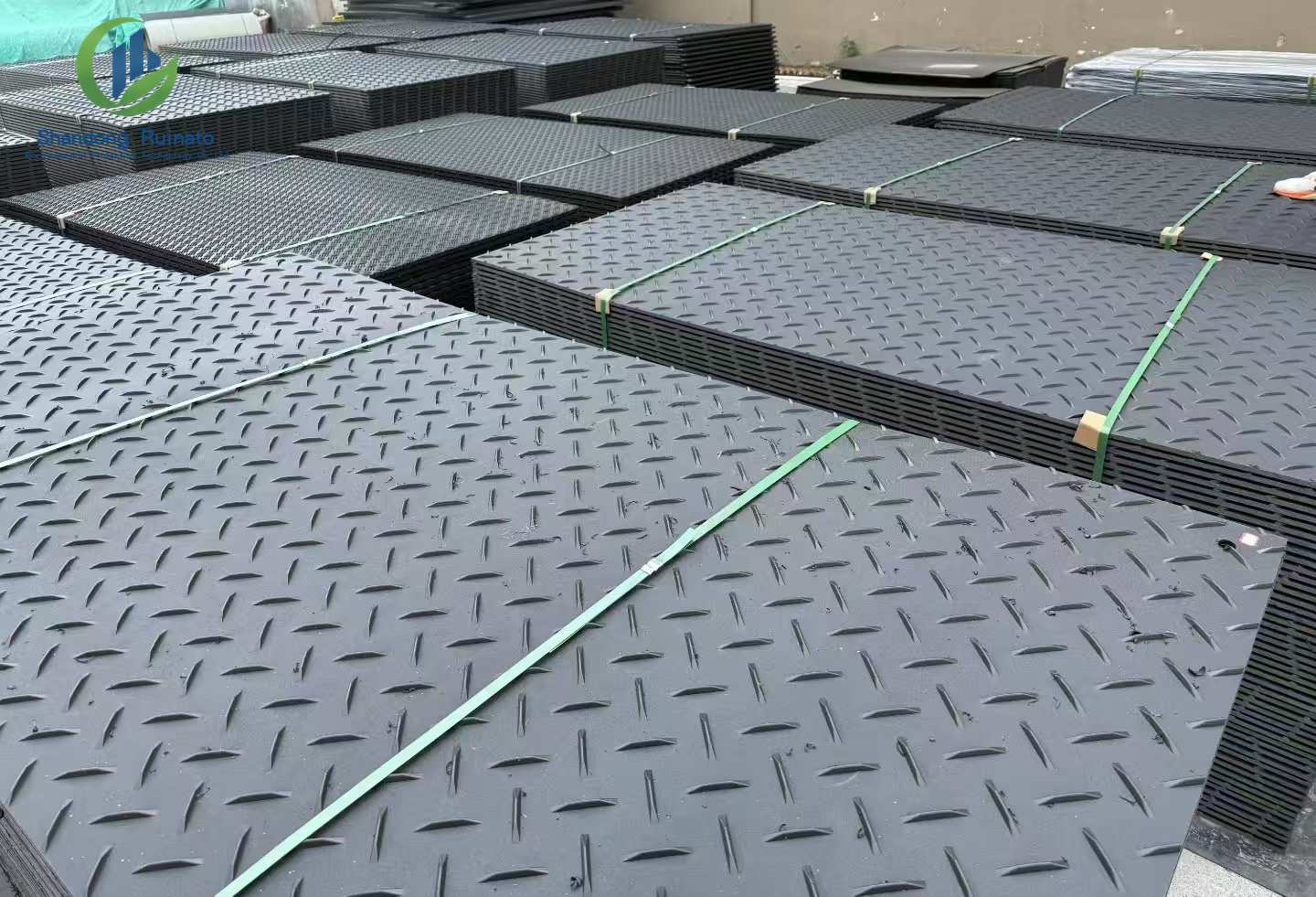
Once the venue layout, ground condition, visitor traffic, and service requirements have been established, the next step is to review the available configuration against the actual event schedule. Shandong Ruinato Environmental Protection Technology Co., Ltd. manufactures engineering plastic products for construction and industrial applications. Its ground protection mats are produced from HDPE and are described for temporary roads, work platforms, heavy-equipment access, lawns, gardens, exhibitions, and events. The documented range includes different panel dimensions and surface-pattern options, together with handling configurations such as integrated hand holes. For project enquiries, venue drawings, protected-area dimensions, traffic requirements, ground conditions, installation dates, and removal schedules provide the practical information needed for technical discussion.
Conclusion
Ground protection for an outdoor event should be planned according to how each part of the venue will be used. Pedestrian routes need attention to traction and transitions, while service roads and equipment areas require closer consideration of loading and ground stability. Weather, drainage, panel layout, installation time, removal, and reuse can also affect the final purchasing decision. A site drawing that separates these conditions gives procurement teams a clearer basis for selecting panel configurations and comparing quotations before the event schedule becomes difficult to change.
FAQs
1. Can ground protection mats be used over grass at outdoor events?
Yes, temporary ground protection systems can be used over lawns and other sensitive surfaces. The ground condition, expected traffic, moisture, installation period, and removal method should be reviewed before the event.
2. What surface should be used for temporary event walkways?
The surface should provide suitable traction for expected weather conditions while remaining practical for pedestrian use. Drainage, texture, transitions, and the surrounding venue surface should all be considered together.
3. Should pedestrian routes and service roads use the same mats?
Not necessarily. Pedestrian routes may prioritize traction, walking comfort, and appearance, while service roads may require greater attention to equipment loading and repeated vehicle traffic.
4. How should mat quantity be calculated for an event?
Begin with the dimensions of each protected area, then draw the selected panel layout. This accounts for incomplete rows, curved sections, entrances, intersections, and other areas that a simple square-meter calculation may miss.
5. What should an event ground protection RFQ include?
Include site drawings, protected-area dimensions, ground conditions, pedestrian and vehicle use, expected weather, installation and removal dates, panel preferences, connection requirements, delivery restrictions, and storage arrangements.