
The safest way to estimate ground protection mats is to calculate from the actual site layout, not from total project acreage. Start with each temporary road, work pad, turning zone, or staging area that needs protection. Convert those dimensions into complete mat rows, add known extra areas, and apply a reserve that reflects project uncertainty. For contractors, site engineers, rental companies, and procurement teams, this approach produces a quantity that is easier to install and purchase than a simple square-foot estimate.
What Site Information Should Be Collected Before Calculating Mat Quantity?
The first task is to define exactly where temporary surface protection is required. Total site area is rarely useful because only part of the project may carry trucks, loaders, cranes, or repeated traffic.
Break the project into measurable zones
Separate straight access roads, branch roads, turning areas, equipment pads, loading points, and temporary work platforms. Calculate each zone independently.
For a straight road:
Protected area = road length × protected width
A 480 ft road with a 12 ft protected width requires:
480 × 12 = 5,760 sq ft
If the project also needs a 30 ft × 40 ft equipment pad:
30 × 40 = 1,200 sq ft
The preliminary protected area becomes 6,960 sq ft.
Irregular areas are easier to manage when divided into smaller rectangles. This also makes revisions easier if the traffic plan changes.
Use operating width, not only vehicle width
A 9 ft wide machine does not necessarily need a 9 ft wide roadway. Steering correction, turning movement, edge clearance, and poor ground beside the route may require extra width.
Before fixing the layout, confirm maximum vehicle width, one-way or two-way traffic, turning points, passing areas, and where equipment must stop or work. Ground condition matters too. A narrow route over compacted gravel may be less risky than the same layout over saturated soil.
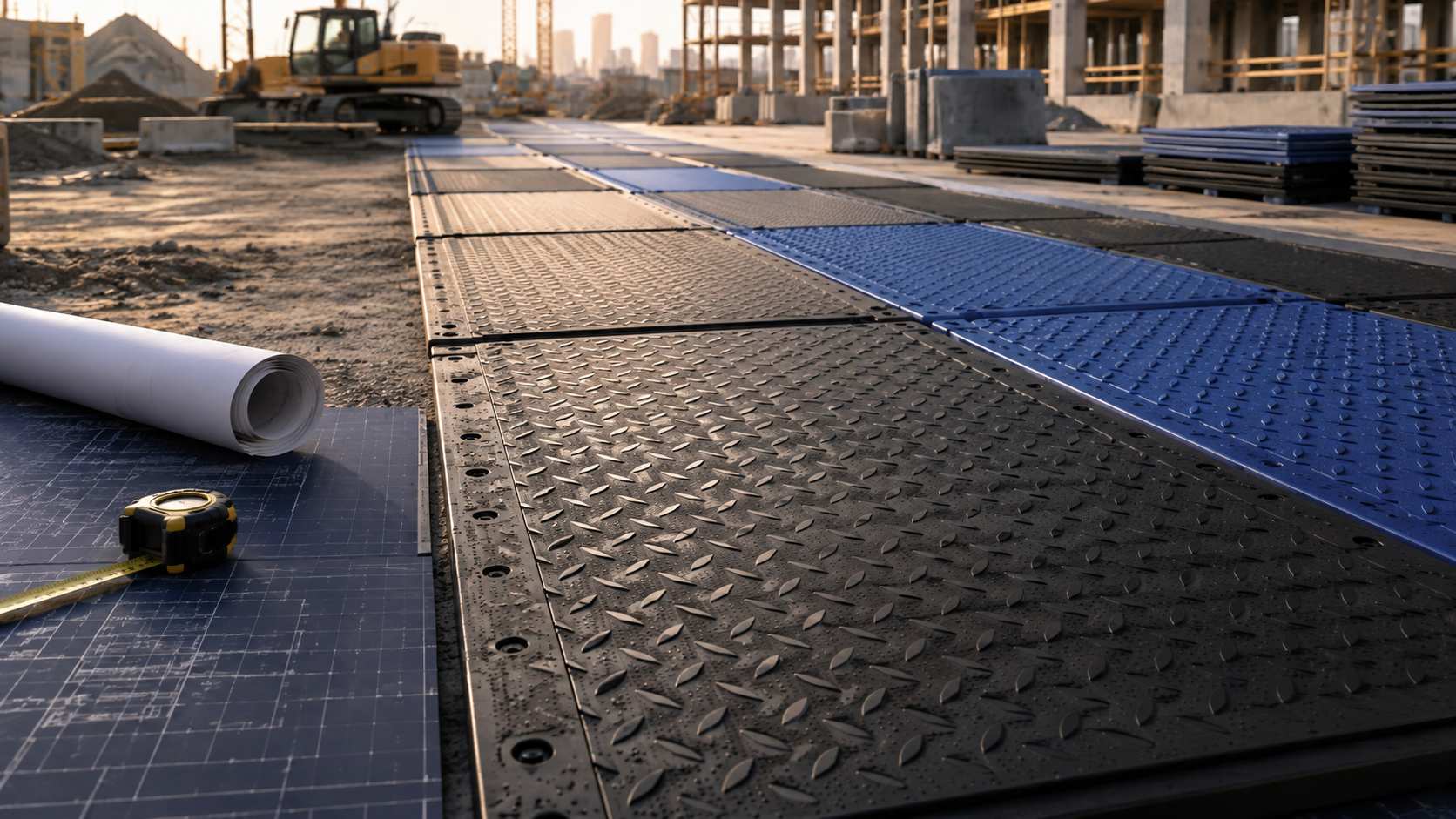
For projects involving temporary vehicle access, the relevant construction application information can help buyers identify where protected access routes and work surfaces may be required. construction application
How Do You Calculate the Basic Number of Ground Protection Mats?
The first quantity comes from panel coverage. Use one unit system throughout and round upward whenever the calculation produces a partial mat.
Calculate nominal panel coverage
Suppose the selected mat measures 4 ft × 8 ft.
Panel area = 4 × 8 = 32 sq ft
For 6,960 sq ft:
6,960 ÷ 32 = 217.5
The basic quantity is therefore 218 mats.
In metric units, a 1.22 m × 2.44 m panel covers about 2.98 m². For 650 m²:
650 ÷ 2.98 ≈ 218.1
Round up to 219 mats.
For early budgeting, this calculation is useful. For long access roads, however, a row-by-row check is more reliable.
Count complete rows for temporary roads
Take a 500 ft road that needs 12 ft of protected width. If 4 ft × 8 ft mats are installed with the 8 ft side running along the route:
12 ÷ 4 = 3 mats across
500 ÷ 8 = 62.5 rows
The last partial row still requires complete panels, so round up to 63 rows:
63 × 3 = 189 mats
An area-only calculation gives:
500 × 12 ÷ 32 = 187.5 → 188 mats
The actual row layout needs 189 mats. The difference comes from the incomplete final row. On routes with several branches or awkward dimensions, the gap can be larger.
How Does Mat Size Change the Final Order Quantity?
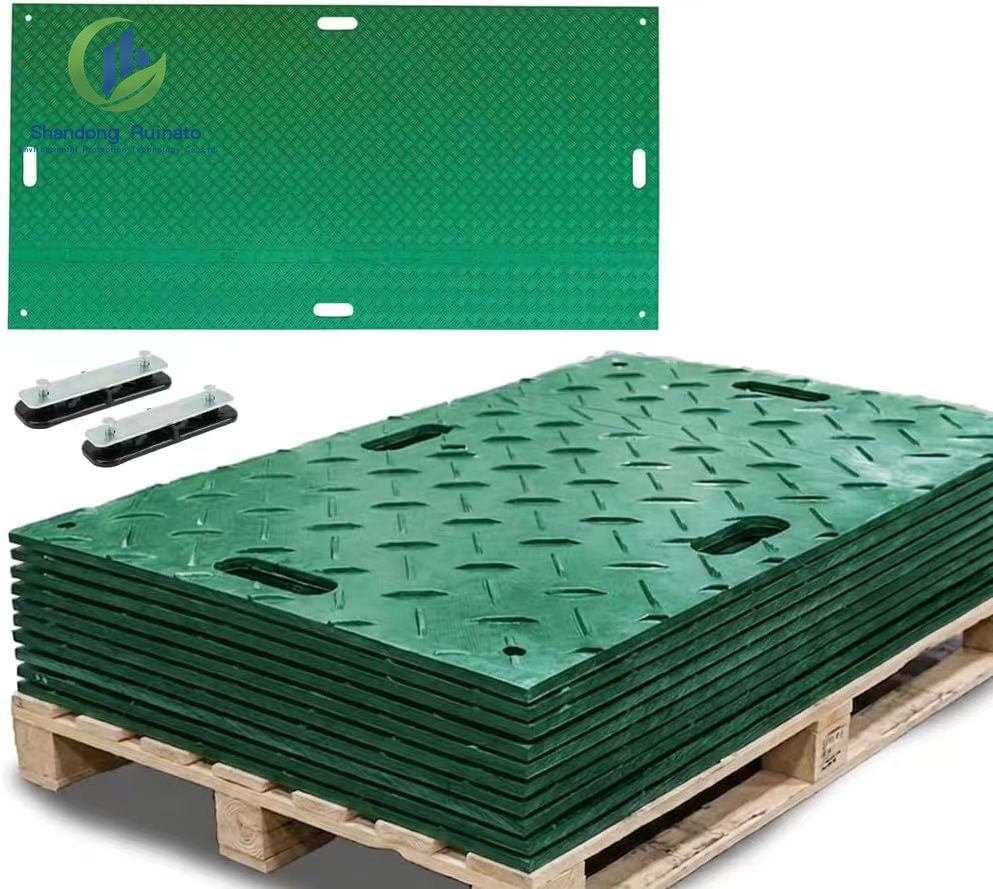
Panel area affects coverage, but panel width often determines whether the layout is efficient. A mat that looks economical by square footage may create unnecessary extra width or incomplete rows.
Match panel dimensions to road geometry
Imagine a temporary road that needs 10 ft of protected width. With 4 ft wide mats, two panels provide only 8 ft, while three provide 12 ft. With 3 ft wide panels, three provide 9 ft and four provide 12 ft.
Neither arrangement gives exactly 10 ft. The buyer must decide whether to accept a wider protected route, change panel orientation, or select another size.
| Mat size | Nominal area | Panels across a 12 ft road |
|---|---|---|
| 4 × 8 ft | 32 sq ft | 3 |
| 3 × 8 ft | 24 sq ft | 4 |
| 3 × 6 ft | 18 sq ft | 4 |
| 2 × 8 ft | 16 sq ft | 6 |
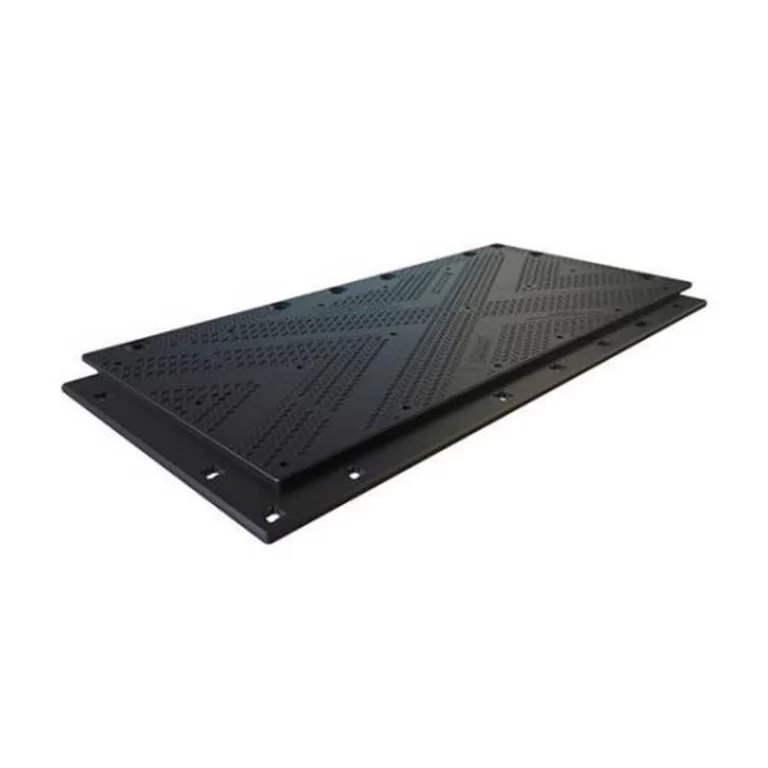
Larger panels reduce the number of individual pieces and joints. Smaller formats can be easier to fit around restricted areas. Buyers can compare available dimensions for heavy duty ground protection mats before fixing the row layout. heavy duty ground protection mats
Include the connection layout
Where mats are connected into a continuous temporary roadway, connector quantity should come from the drawing rather than from a rough “connectors per mat” assumption.
An internal panel may connect on several sides, while an edge panel may need fewer connections. Intersections and widened areas create different patterns again.
Mark mat orientation, complete rows, branches, corners, and connection lines on the site plan. Where a continuous assembled surface is required, interlocking ground protection mats may also be worth reviewing because their connection arrangement affects panel and accessory quantity. interlocking ground protection mats
What Extra Mats Should Be Added for Turns and Work Areas?
A straight road is efficient. Real construction sites usually include bends, staging areas, loading zones, and equipment work areas.
Calculate known extras separately
Suppose the main road requires 189 mats and a 24 ft × 24 ft turning pad is also needed.
24 × 24 = 576 sq ft
Using 4 ft × 8 ft mats:
576 ÷ 32 = 18 mats
Record those 18 mats as a separate line item. Use the same method for branch roads, crane approaches, loading zones, work pads, and temporary parking areas.
| Area | Mat quantity |
|---|---|
| Main road | 189 |
| Turning pad | 18 |
| Equipment pad | 30 |
| Branch road | 21 |
| Subtotal | 258 |
| Reserve | Project-specific |
This method is more transparent than hiding every irregular area inside one blanket contingency percentage.
Set the reserve from project risk
There is no universal spare percentage that suits every job.
A fixed route with easy replacement delivery may need little contingency. A civil project with moving excavation fronts and frequent traffic changes may require more flexibility.
Before setting the reserve, ask whether the route may change, how quickly replacement mats can arrive, whether panels will move between work fronts, and what happens if several mats become unavailable.
The reserve should reflect those risks, not simply follow a habitual 5% or 10%.
What Should Buyers Confirm Before Sending a Purchase Order?
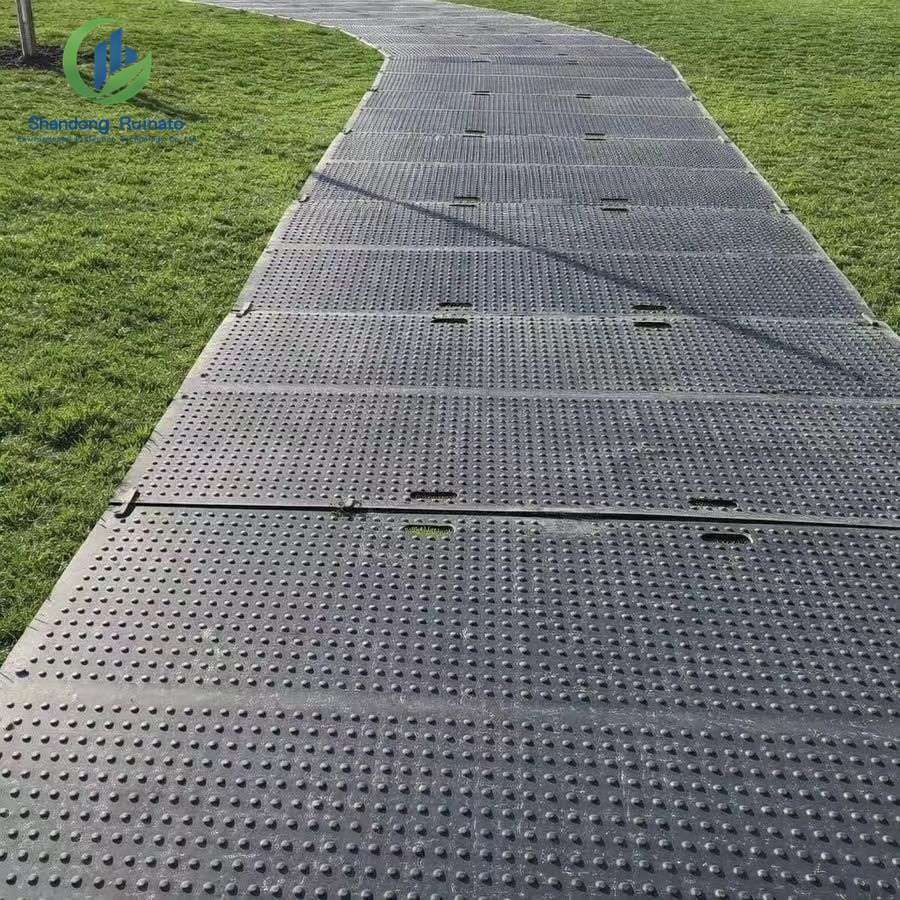
The final quantity should be tied to a purchasing specification. A correct mat count can still create site problems if panel dimensions, connections, traffic conditions, delivery, or storage have not been defined.
Turn the estimate into a purchasing checklist
Before requesting a final quotation, confirm:
- Route length and protected width
- Dimensions of turns and work areas
- Ground condition
- Heaviest expected vehicle or equipment
- Preferred panel dimensions
- Panel orientation and complete row count
- Connection requirements
- Reserve quantity and its basis
- Delivery date, unloading method, and storage space
A final layout drawing should show where the road changes width and where extra panels are required. That drawing becomes a common reference for procurement, delivery, and installation.
If the project has not yet fixed a panel configuration, comparing the wider ground protection mat range can help determine which dimensions fit the route most efficiently. ground protection mat range Once dimensions and quantities are confirmed, the site plan and equipment information can be submitted through the project enquiry page for quotation review. project enquiry page
Who Can Support Ground Protection Mat Selection and Quantity Planning?
Shandong Ruinato Environmental Protection Technology Co., Ltd. supplies engineering plastic products for construction and industrial applications. Its ground protection range includes heavy-duty and interlocking configurations intended for temporary access and surface protection requirements. Buyers can provide route dimensions, ground conditions, expected equipment, connection requirements, layout drawings, and delivery schedules when discussing a project. Matching the panel dimensions to the site geometry before finalizing quantity can help procurement teams avoid both incomplete road layouts and unnecessary excess panels.
Conclusion
Calculating ground protection mats begins with area, but the purchase quantity should come from the actual layout. Measure roads and work zones separately, choose panel dimensions, count complete rows, add turning and staging areas, and set a reserve based on real project uncertainty. Before ordering, place the proposed panels on a dimensioned site drawing and check connections, delivery stages, and storage. That final review gives procurement and site teams a more dependable quantity than square footage alone.
FAQs
1. What is the basic formula for calculating ground protection mats?
Divide the protected area by the nominal area of one mat, then round upward. For temporary roads, verify the result by calculating complete rows across the width and along the route.
2. How many 4 × 8 ft mats are required for 1,000 sq ft?
A 4 × 8 ft mat covers 32 sq ft nominally. Dividing 1,000 by 32 gives 31.25, so at least 32 full panels are required before layout adjustments.
3. Why can row calculations require more mats than area calculations?
Road dimensions may not divide evenly by panel dimensions. The remaining fraction of a row still requires complete mats, so the practical layout quantity can exceed the area-based estimate.
4. How many spare ground protection mats should a project order?
There is no universal percentage. Reserve quantity should reflect route changes, replacement lead time, relocation plans, storage space, and the operational cost of running short.
5. What information should be sent to a ground protection mat supplier?
Send route dimensions, work-area sizes, vehicle information, ground conditions, panel preference, connection requirements, quantity calculations, reserve quantity, site layout, delivery schedule, and unloading arrangements.